Visiting the Digital Humanities Lab

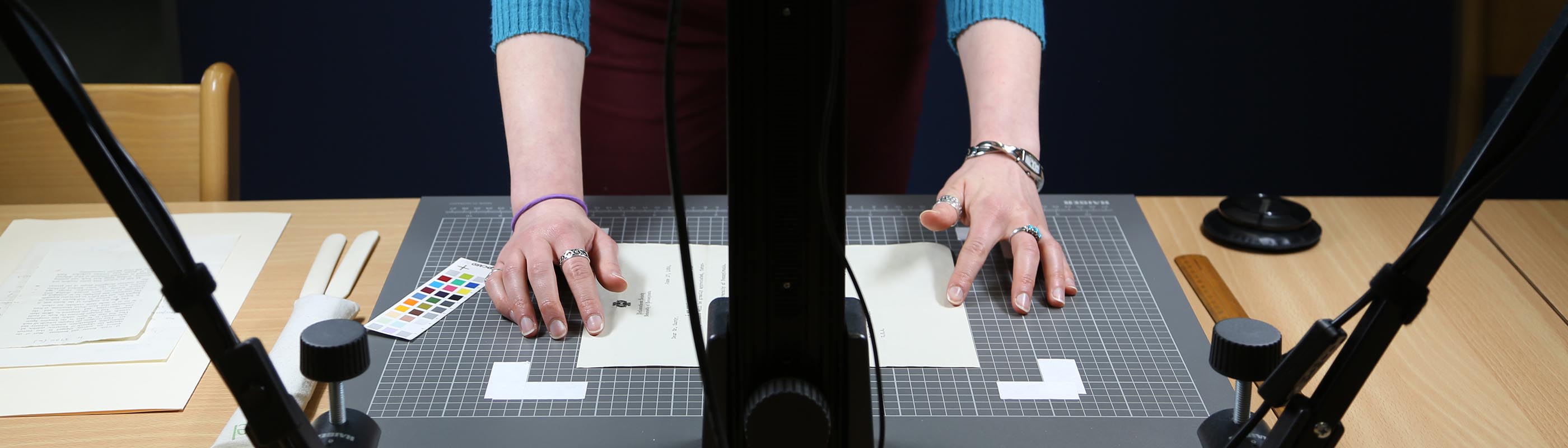
I’m Carla, a visiting postgraduate research student from Ludwig-Maximilians-Universität (LMU) in Munich. I study Digital Cultural Heritage and have had the opportunity to do a one month-long research internship at the DH Lab. Despite my limited time here, I gained many new skills and got familiar with what it is like to work in a lab. I got to work around several members of the DH team, got to meet professors working in the field and got a tour of the Special Collections in the Old Library which gave me further insight into the broad range of research that is being conducted in the field. During my time here I received training in 2D-Digitisation, audio editing, RTI, Photogrammetry and 3D-printing. What made this exciting for me was being able to apply the knowledge that I gained from my home-university but also the opportunity to figure things out myself.

I digitised some of the old Exeter Theatre Royal playbills at the beginning of my time and learned to edit audio files but soon found myself invested in RTI and 3D-Modelling and Photogrammetry. I really enjoyed working with cameras and figuring out the effects of different camera settings, which plays an important role for RTI and Photogrammetry. Especially RTI was a lot of trial and error, making satisfying results even more rewarding.

 RTI of a Mussel (Normals Visualisation)

I walked around campus to capture objects for photogrammetry, some of them I uploaded on my Sketchfab (https://sketchfab.com/Carla_Ruf). My favourite sculpture that I made a model of is the “Stargazer” at Queens café. Though it had its challenges it made me more familiar with the photogrammetry and the 3D-Modelling software to get my model ready for 3D printing. I ended up printing two of my models which helped me understand how to process and clean them properly.

Photogrammetry model and 3D print of Stargazer
3D print of End Maze III sculpture

My time at the DH Lab was an incredibly interesting experience. The team has been so helpful and accommodating. I’m truly grateful for my time here.

Digital Humanities Interns 2024/25

Each year we ask our interns to write a post reflecting on their time working in the DH Lab. Here is Charlie’s post:

Being a DH intern has been one of the greatest opportunities I’ve ever had. It’s been my favourite job by far, always something new and exciting awaiting for me when I get in for my shift. I have been able to work on a range of projects from photography to audio editing. Coming from a photography background it was great to be able to use my skills in new ways and interact with the actual archival material. It is impossible to include all of the activities and great projects I’ve been involved with over the past nine months but here are some of the highlights.

To get us used to Lab 1, all of us interns began with the digitisation of Exeter theatre playbills. It helped me feel connected to the history of Exeter and I was excited to see this playbill advertising Henrik Ibsen’s play The Doll House which I studied for my international baccalaureate.

Using the same skills, I had the chance to photograph some of the Busy Bee collection. As an English literature student, it was wonderful to photograph these bound letters and as someone who still writes letters to people it led me to think about the importance of material culture and how special the written form is.

One of the great things about the Digital Humanities Lab in Exeter and Special Collections is their focus on Southwest archival material. I didn’t know about the mining culture and school that existed before taking photos of The Camborne School of Mines Magazine. I was able to go through the entire process of physical print to searchable PDF which as a student I know the value of. It’s fantastic to think I was behind a process which will allow future researchers to interact with them.

This internship came with lots of training in all parts of the digital humanities world. Having been a long-time fan of photography, it was great to see how photographic practices could be used in different ways to create 3D effects. I had never done photogrammetry or RTI before and I loved being able to experiment with new modes of creating photographs which are interactive and offer 3D applications.

Another great gem of the DH lab is the 3D printer and since being able to work with a 3D printer it is now one of my life goals to own my own. Using TinkerCad I was able to design and make two of my own creations including a Christmas tree decoration for DH as well as develop a column structure for a model of a globe I own. It was wonderful to see the real world (and fun) ways 3D printing can be used. When it came to open days, I loved talking visitors through the process of creating replicas of the votive of the lady, showing why the digital humanities is so important in maintaining culture and heritage. To see this get made into a greater project where I was able to create my own wax votive and be part of a widening tradition, seeing how each step came to be, felt incredibly special.

But my favourite project to be involved in was ‘Section 28 and its afterlives’. Working closely with Dr Chris Sandal-Wilson I edited interviews to create audio excerpts for the project’s website. Whilst this led to many hours being holed up in Lab 3 and becoming very familiar with Audacity, I loved listening to people’s experiences, and I loved the feeling of being part of something larger. I had never done audio editing before, but I was determined to learn as much as I could to create something that would continue on and have a legacy. It was great to then put my newly learned HTML skills to the test to put the audio excerpts on the website and be part of the decision-making process for the way the project moved forward. Whilst I’ve had a lot of fun, making and creating things for both me and as part of projects, this project brought home the value of the digital humanities and the important role it plays in maintaining and preserving history and culture.

This internship would never have been as good as it has been without the constant support and friendship from the amazing Digital Humanities team and my fellow interns. I will not only miss the work, I will miss banding together to listen to Cornish farmers from reel-to-reel tapes, hanging out in the breakout space over coffee even if we weren’t scheduled to work and sharing photos of when our photogrammetry processes didn’t go quite right. It’s sad to leave but I know there will be a new band of interns who get the fantastic chance to work as part of the best internship scheme!

Digital Humanities Interns 2024/25

Each year we ask our interns to write a post reflecting on their time working in the DH Lab. Here is Evelyn’s post:

I’m Evelyn, and I’m a second-year English student coming towards the end of my internship. It has been so much fun. I’ve always wanted a way to connect my passion for English and Computer Science together and I think I’ve finally found my answer. I’ve never real understood cameras and photography, and so that was a big learning curve to start but now I feel I understand it all a lot better, and now have confidence in my photography.

My biggest project was probably digitising some old coins using RTI. I’ve loved revealing all the little indents and scratches. Then I used HTML code to put my work as a webpage on the Exeter RTI website! This was challenging but a lot of fun. Also, I’ve now experimented with Audacity and editing old reel-to-reel tapes to try and reveal the voices behind the distortion. Translating Hertz and Decibel graphs to find the exact frequency of the distortion to start removing it.

I’ve also got to explore using code to create 3D models and managed to create a shark which I successfully 3D printed.

Finally, I loved getting a glimpse into the VR Shakespeare project. This was my first time using VR and I thought it was mesmerising and something I really want to explore more in the future. Thank-you very much DH.

Digital Humanities interns 2024/25

Each year we ask our interns to write a post reflecting on their time working in the DH Lab. Here is Sam’s post:

Hey, I’m Sam Harvey, and I’m a third year History and Archaeology student. I could not have imagined how much fun I would have had on this internship, it was an incredible experience, and I am certainly going to miss it when I graduate.

In this role, I have been taught how to use many different digitisation techniques, including photogrammetry and the making of 3D models, Reflectance Transformation Imaging (or RTI), 3D printing and more. The DH Team allow you to specialise into doing the techniques or working with the material that you find interesting or fun, which makes this internship very enjoyable. I personally specialised into working with documents that needed to be scanned and digitised, and artefacts from archaeology teaching packs that needed to be turned into 3D or RTI models, using photogrammetry or RTI respectively. 

There are also many different types of materials that I worked on, including artefacts, reel-to-reel tapes, posters, paintings, postcards, photographs, and more. I, along with my fellow interns, have been a part of many different projects throughout the course of the internship, and it was exciting because we never really knew what we were going to do each shift.

I particularly enjoyed working with the collection of playbills from the Theatre Royal in Exeter, as I had always wanted to handle old documents and artefacts, and some of these playbills had the most amazing illustrations on them.

I also really enjoyed working with the archaeology teaching packs, and I produced photogrammetry models of many different artefacts such as metal, pottery, baskets, fibres, bone and antler. Below is one of my nicest models, which is of a piece of antler that has been sliced in half, and you can see it still has a high amount of detail to it. 

I also made RTI models of many of the artefacts, such as the one below, which is of a strand of fibre from the teaching pack on basketry. I was also encouraged to experiment and make models of my own objects, so I made RTI models of some coins I had.

If I ever needed help with these techniques, I never felt too nervous to ask a member of the DH team for help, because they are so understanding, supportive and more than happy to help. Working on the desk was also useful, as it gave me more time to work on these techniques and it allowed me to build my confidence and my ability to help people with queries they had.

Again, I am really going to miss this internship, and I highly encourage anyone with an interest in history, archaeology or preservation to apply for the position, because you won’t regret it! I certainly didn’t!

Digital Humanities interns 2024/25

Each year we ask our interns to write a post reflecting on their time working in the DH Lab. Here is the first of this year’s from Natasha:

I’m Natasha, a third year Archaeological Science student. My internship here at the Digital Humanities Lab is coming to an end but working alongside the DH team has been the most incredible experience for gaining new skills and has provided me with the opportunity to collaborate in a range of projects with my fellow interns.  

With weekly training by members of the team, I have worked on different projects including photography, photogrammetry, and Reflectance Transforming Imaging (RTI) of Archaeology Teaching Packs, digitalisation of Exeter Theatre Playbills, and recording audio cassette tapes. I was also encouraged to try individual work and put these skills into practice with objects that I own, allowing the ability to explore personal interests. This includes using the 3D resin printer to reconstruct biface tools and completing RTI on a coin I own that had unrecognisable features before processing with RTI software, RelightLab.

Additionally, working once a week on the advisory desk has given me more confidence in the background administrative work that occurs for research projects and day-to-day support provided by the lab, including equipment hiring, assisting in queries, and setting up seminar rooms for conferences. 

This internship has allowed me to engage in innovative digital preservation, meet new people and learn skills that previously, I had no experience in. I hope to pursue my masters programme at Exeter using the tools I have acquired, focusing on digitalisation and preservation of archaeological artefacts. I am so grateful for all the support the DH Team has given me this year, and I could not recommend enough joining this internship to see what projects you could get involved in! 

Digital Humanities Interns 2023/24 part 4

Each year we ask our interns to write a blog post at the end of their time working with us looking back on their time in the DH Lab. Here is the fourth of this year’s blogs from Phoebe:

Hi, I’m Phoebe and I’ve just completed my internship at the Digital Humanities Lab here in Exeter alongside my course as a second-year History and Archaeology student. It seems to have flown past but looking back I’ve had such an amazing experience as an intern at the DH Labs and have worked on a huge number of projects- I’m not sure how we fit it all in! 

During my time at the Labs, I’ve worked on digitising the Theatre Royal, Exeter Playbill Collection, Institute of Cornish Studies Elections Project and the Family Farming in West Penwith Tapes for Penryn Archive as well as recently working on creating photogrammetry models for the Archaeology teaching packs. I’ve also has great fun playing with the 3D printers at the labs, making cute Christmas decorations and experimenting with different designs.  

 My first successful 3D print! 

In-between all that, I’ve worked closely with Adrián Oyaneder, creating 3D models using photogrammetry from photos he took of petroglyphs in the Atacama Desert. It was this project which inspired me to pursue my dissertation topic where I’ll be using the skills and techniques I’ve learned from working at the Labs. My colleagues at the DH Labs have been incredibly supportive and encouraging of my dissertation project so I’ve really benefitted from all their innovative help and enthusiasm to experiment.  

 Photogrammetry model of rocks near Reed Hall as practice for my dissertation work 

Experimenting with RTI in the field 

It’s amazing to think of how much has been done in only a year, especially when I came to this opportunity with no prior skills or experience in this field. My colleagues here have been brilliant in their support and patience as they taught me all they know and helped develop my confidence when working with technology while overcoming its challenges. I’ve learned so much, from 3D capture techniques like photogrammetry and RTI, to how research is effectively conducted and what is involved when storing and caring for delicate archived materials. I’ve also gained a new appreciation for just how valuable digital heritage is in today’s world. Working with digital heritage in such a direct and active way has given me a taste of what this environment is like and encouraged me to pursue it after I graduate.  

I’ll be sad to leave this internship, but I’ve loved working with my fellow interns and the DH team! 

Digital Humanities Interns 2023/24 part 3

Each year we ask our interns to write a blog post at the end of their time working with us looking back on their time in the DH Lab. Here is the third of this year’s blogs from Sophie:

I have found my time working in the Digital Humanities Lab to be an incredible learning opportunity and it has taught me invaluable skills using technologies I had not had the opportunity to work with before. The DH team provided a variety of weekly training sessions such as in using RTI (Reflectance Transformation Imaging), 3D printing, photogrammetry and coding, amongst other things, allowing me to complete projects in fields which I had never encountered before!
The first project I took on was digitising reel to reel tapes for Penryn campus, the tapes contained interviews with Cornish farmers and so were a really interesting piece of oral history, especially as they referenced the surrounding areas in Devon and Cornwall! The project allowed me to learn how to use the tape-recording equipment as well as how to edit and enhance audio on Audacity, this helped me with my Art History assignments as we were tasked with creating an app trail for our field trip to Florence; the skills I learnt at my internship were really helpful in the recording and editing of this material. We also, as an intern team, transcribed these recordings of the Cornish farmers using AI software, which made the recordings more accessible as the AI was able to pick out sections of audio which were hard to hear normally which really brought the interviews to life!

Another fun project I was apart of was helping one of the researchers in the lab with remote archaeological sensing in Chile, this involved using Google Earth Pro to spot new archaeological sites in the Chilean mountains. Another intern and I, with guidance from researcher Adrián, were able to spot historic farming sites, small settlements and animal traps. This was an immensely rewarding project which I never would have had access to without the Lab!
As well as these I also took on smaller personal projects, after the 3D print training I used Sketchfab to create my own chess piece which I then went on to 3D print using the Ultimaker. It was amazing to be able to hold the final product knowing I had designed and printed it myself!

The highlight of the internship for me was the trip to Special Collections in the Old Library as it introduced me to resources on campus I had previously been unaware of. Their collection of South West authors was fascinating and it was a special moment to see the original manuscripts of two of my favourite books (Rebecca by Daphne du Maurier and Lord of the Flies by William Golding) in person as well as a first edition of Dracula!

My internship at the Lab has taught me so much and has given me skills I have been able to develop not only through my projects in DH but also in my degree. Thank you to the entire DH team for an amazing year and I hope the new interns have as much fun as I have!

3D Printing Display

The objects you can see here on display here have been made by our Digital Humanities staff members and interns. They illustrate the range of projects the lab has worked on since it opened in 2017 and demonstrates how we have harnessed the potential of 3D printing to bring objects from the past to life. Take a look at the display in the Digital Humanities Lab breakout space to learn more.

What is 3D printing? 3D printing is the process of creating a three dimensional object layer by layer using computer created design. In the Digital Humanities Lab we mainly print in PLA (Polylactic Acid) plastic and resin as these are well suited for creating high quality replicas.

3D printing is a extremely valuable tool for the digital humanities as it enables the recreation of historic objects that reflect the details and intricacies of the original artifact. 3D printing encourages accessibility as it means that we can handle and learn from the replicas without damaging the originals.

At the Digital Humanities Lab we use photogrammetry, which is the process of taking multiple overlapping photographs of an object. This creates a digital 3D model which can then be printed into a physical object.

Litho Print and Exeter Rock. The photograph of the DH Lab and resin model of the Exeter Rock demonstrates the range of models we can create using a variety of materials.

Blue Boy Statue. The model you can see on display is a replica of the original statues which were made to commemorate the rebuilding of St John’s Hospital School between 1859-60 which was set up as a charitable foundation. Students at the school were nicknamed the Blue Boys as the students wore blue caps and gowns. The original cast iron statues are now displayed in Exeter School Archives, The Maynard School, Princesshay shopping centre and Royal Albert Memorial Museum.

Pick up the Blue Boy to see the internal structure of the print as the model is created in layers where each layer forms a cross section that supports the next.

Wax Votive Offerings. Circa 15th Century. Following bomb damage to Exeter Cathedral in 1942, several medieval wax votive offerings were discovered behind a stone canopy. They comprised of: a horses head, feet, heads, hands, a foot in a pointed shoe and a complete female figure. As these objects are extremely fragile they are not on public display. The Digital Humanities Lab combined photogrammetry, 3D printing and wax casting to create replicas, thus enabling more people to explore the fascinating details of these rare historic items.

Early Christian Bread Stamps. Held in trust by the Royal Albert Memorial Museum, this double sided early Christian bread stamp has a monogram of Christ on one side and A O on the other which symbolises alpha and omega. This is thought to be used for stamping Eucharistic bread. Pick up the stamps to feel the difference between resin and PLA filament prints.

Granite boulders (AD 1000-1200). Granite boulders with late pre-Hispanic colonial, and sub-contemporary rock engravings from the archaeological site Pampa Chiza, located in the Atacama Desert, northernmost Chile. This site features over thirty engraved boulders with zoomorphic, anthropomorphic, geometric, and abstract figures. The high frequency of high mountain fauna such as rheas and camelids, combined with human figures rowing on sea rafts, and its unique location between the Pacific Ocean and the Andes mountains, highlight the dramatic contrasts of this desert landscape as a gateway between the sea and the high mountains. The granite boulders were captured in 3D via structure-from-motion photogrammetry and have been printed in resin.

Geographical Landscapes. Using aerial drone photography we can create 3D models of large landscapes and reduce the scale to create miniature replicas. These models reveal the surface texture and terrain of hill forts which are of archaeological significance. These are useful teaching tools for students as it enables them to learn about places that would otherwise be inaccessible.

Sound Waves. In the Digital Humanities Lab we work with audio and visual media, specialising in podcast production and recording oral history interviews. This experimental print was made as a teaching tool to visualise the sound waves and meter in poetry.

Digital Humanities Interns 2023/24 part 2

Each year we ask our interns to write a blog post at the end of their time working with us looking back on their time in the DH Lab. Here is the second of this year’s blogs from Daisy:

Working as part of the Digital Humanities Team alongside my third-year studies has been an incredible opportunity. From processing reel-to-reel tapes of Cornish farmers to building 3D prints in the Makerspace, this placement has taught me an astounding range of technical skills that I look forward to applying in my further study and future career. A particular highlight was getting to explore the audio-visual suite, namely, practise recording and editing my own pseudo-scripts. As an aspiring journalist, this was invaluable and immediately applicable to my goals beyond university study as well as proving to be the perfect titbit to bring up in my master’s interview!

Beyond media experience, the DH Lab provided the support to pursue my interest in textile history. I was able to look through a large collection of scraps collected by a 19th century socialite which detailed her dresses and their adornments. From this, coupled with my use of the lab’s access to Adobe Photoshop while working on the front desk, I was able to reconstruct an approximation of what a whole piece of fabric may have looked like from a two-by-six-inch scrap of embossed satin. ‘The Art of Fiction’ project (@artfictionproject) who had previously posted the page of the book containing these small snippets of fabric then uploaded this image onto their Instagram page. It was wonderful to get the chance to breathe new life into a beautiful piece of textile history and to then have this shared where it would most be of interest. Working as part of the DH Lab often means working with the wider University team, across both the Streatham site and Penryn archives, and this small project provided a micro-scale model of the creative community Digital Humanities forms a key part of.

As well as the chance to work on my own projects, shifts spent in the lab offered a variety of ways to process and digitise media. This involved spending time taking high quality 150mp photographs of 19th century playbills, school photographs from the 1970s and small letters that sometimes included absent minded sketches made by the author. As well as professional archival photography and audio-visual editing, the intern team were regularly trained on new equipment. These techniques included photogrammetry, namely constructing 3D models from repeated and slightly differing photographs, and RTI, photographs taken at different heights and angles of light in a specially constructed dome. These training sessions fed into our individual lab sessions in which I began my RTI work by processing handmade lace from a team member’s collection. From further discussions with Gary Stringer on his collection of textiles, he brought in a set of lace bobbins and explained the history of lacemaking itself, specifically regarding Bedfordshire lace. I was then lucky enough to try out a few basic stitches and am now searching for a set of bobbins for myself!

Although my degree and much of my work has focused on the humanities, I’ve enjoyed the more mathematical, technical side of work at the lab just as much. Taking on this placement with the lab has shown me how my degree significantly overlaps in the real world, using skills from both Art History and Mathematics together to produce digital resources. Both Julia Hopkin and Gary Stringer have provided invaluable teaching on the applications of coding, guiding the internship team through the basics of coding and Badger 2040 badges.

One of my last commitments as an intern was helping at the Open Day for the university, answering visitors’ questions and providing tours around the lab. It was the perfect day to bookend both my student experience and my time at the lab, showing potential Exeter University students around the facilities and speaking about how much the DH Lab has to offer.

Reflecting on my time with Digital Humanities, I would highly recommend anyone interested to apply to the internship placements. As a truly entry-level job, you work as part of a supportive and welcoming team to learn countless professional skills that are useful in any industry and provide you with a foundational knowledge of the work environment while you study. It has made what would already have been a memorable year even more so and I can’t thank the team enough for their enthusiasm and generosity!

Digital Humanities Interns 2023/24 part 1

Each year we ask our interns to write a blog post at the end of their time working with us looking back on their time in the DH Lab. Here is the first of this year’s blogs from Emily:

Hi – I’m Emily, a second year English and Communications student and 2023/24 intern here in the DH Lab. Working in the Digital Humanities Lab this year has been an amazing experience and one which has provided new ways to engage with my own academic and creative endeavors – my favourite aspects of the job have been developing new technical skills and getting the opportunity to support current research. 

At the start of the year, we received training in photography, photogrammetry, RTI, and eventually 3D printing. I really enjoyed seeing these skills build on each other with the progression from taking high quality images, to how 3D models can be made from those photos using Agisoft Metashape, and then learning how to use the 3D printer in the Makerspace to make physical objects from the models. Here are some of the models I made during training in the autumn term: 3D models by echircop – Sketchfab 

My favourite things I 3D printed were these articulated lizards, using multicoloured filament – these were always popular on open day tours too! 

Besides taking photos in Lab 1 and 2 to digitise a variety of paper archival collections, the projects I spent the most time on were audio and video editing. Firstly, I worked on the Cast in Stone project, editing interviews about the legacies and impacts of colonial statues on their local areas. I mainly cut out erroneous or irrelevant material from the interview audio and added title cards. This was a great opportunity to learn new software, as I had not previously used Adobe Premiere Pro, and I enjoyed getting to use my technical skills to make these interviews publicly accessible. They are available here: Cast in Stone Interviews 

A screenshot of the editing process in Adobe Premiere Pro

Alongside the other interns, I also worked on a set of interviews with Cornish farmers from the Penryn Campus archive. These were recorded on reel-to-reel tapes, which were digitised in Lab 3, and many had poor audio quality. I used Audacity to amplify the volume of the recordings and remove as much background noise as possible, which was a fun and experimental process of figuring out what worked best on each individual recording. Following this, I used software called TurboScribe to create transcripts of each recording. This came with some challenges, as the software couldn’t always accurately transcribe due to accents and remaining issues with audio quality, so a lot of manual edits were necessary. This project was a valuable experience of the many moving parts and various stages that go into audio digitisation, and how to stay organised during this process. We kept a detailed spreadsheet and notes so that the whole team working on it was continually updated. I particularly enjoyed the experimental nature of many parts of this project, as it allowed me to deepen my knowledge of audio editing and try out new things like transcription.

I have loved working in the DH Lab this year! It has been exciting to explore the wide range of activities that fall under digital humanities (alongside what I’ve already mentioned, I was able to learn about coding, handling different kinds of archival objects, and making digital editions of texts) and working with such a supportive and enthusiastic team has been wonderful. I would highly recommend any students reading to consider getting involved with the DH Lab by applying to next year’s internship or looking into HASS modules that engage with digital humanities – you might be surprised by what you can learn!